

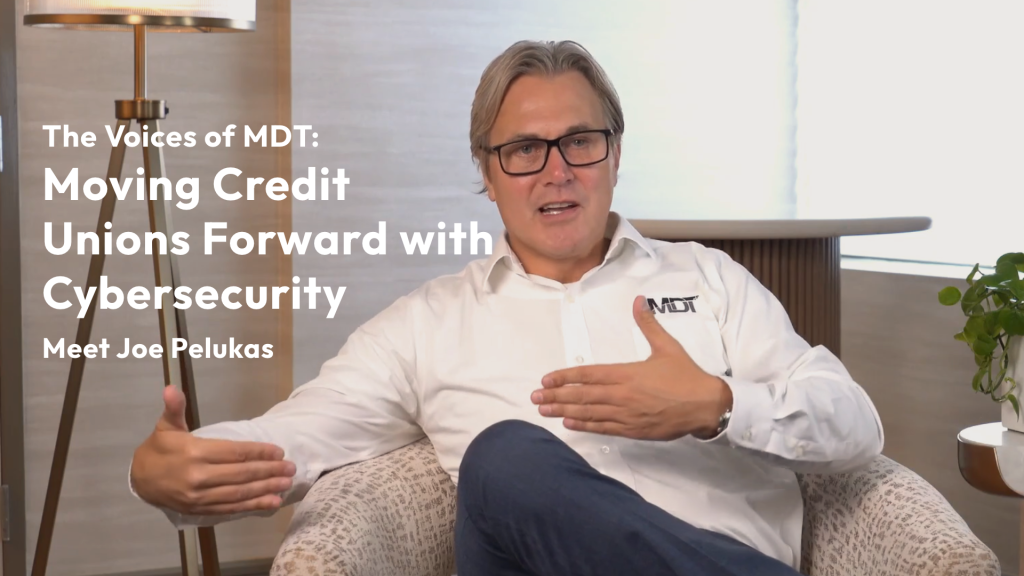

Every new technology, vendor relationship, and member service starts with an opportunity. Cybersecurity has a role in helping credit unions pursue those opportunities while protecting the people who count on them.
For Joe Pelukas, MDT’s Vice President of Security & Compliance, security belongs in the conversation early and throughout the planning process.
In this edition of The Voices of MDT, Joe shares his perspective on security as a business enabler, what preparedness looks like beyond a written plan, and how credit unions can focus their efforts where they matter most. During Cybersecurity Awareness Month, his message offers a practical starting point: security belongs in the decisions moving your credit union forward.
Trust Starts with Protecting What Matters
Members trust their credit union with sensitive information and their life savings. Protecting both is fundamental to maintaining the relationship. The same expectation extends to the partners supporting the credit union.
“What credit union would want to work with MDT if we can’t protect their systems and protect their members?” Joe asks.
The connection between protection and trust is why Joe believes security deserves a strategic role. When teams consider security early, they have time to understand risks, evaluate controls, and find a responsible path forward.
A new tool, for example, may look like a good fit until a late security review reveals it cannot support a required control. Bringing Security & Compliance into the evaluation gives everyone the opportunity to address those questions before decisions are made.
Put Your Preparedness into Practice
Having an incident response plan is an important step. The people responsible for carrying it out also need to understand how to use it.
“You don’t want what’s called a paper tiger, just something that’s written down,” Joe says. “You want the document to be useful.”
Running through scenarios helps teams assess whether their plan reflects what they would need to do during an incident. Are roles and responsibilities clear? Does everyone understand who can communicate with whom? Does the plan provide useful direction for the situation being tested?
These conversations give teams an opportunity to identify gaps and become more familiar with their responsibilities before they need to act under pressure.
Build Verification into Vendor Relationships
Credit unions depend on third parties to support their operations and member experiences. Those relationships make vendor risk an important part of the security conversation.
Joe’s approach follows a familiar principle: trust, but verify.
He explains how MDT assesses risk before onboarding vendors whose systems will integrate with the core or other systems MDT manages or helps manage. The review considers both the controls a vendor has in place and whether its technology can support MDT’s requirements.
Doing this work upfront helps teams make informed decisions about the partners and technology they bring into their environment.
Start with What You Have
With competing priorities and limited resources, knowing where to focus can be a challenge. Joe recommends starting with the tools and capabilities already in place and looking for opportunities to strengthen them before adding more.
“You can’t do everything at once,” he says.
Credit unions also need to understand what data they hold, where it resides and which systems and information are most critical. Identifying these “crown jewels” gives teams a clearer basis for setting priorities and building protection around what matters most.
Progress starts with understanding your environment and making deliberate choices about where to direct your attention.
Make Security a Two-Way Conversation
Joe sees his role as both a navigator and a trusted advisor, bringing perspective to the conversation while taking time to understand what a credit union wants to accomplish.
“Security shouldn’t be scary,” he says.
Security & Compliance teams have a responsibility to listen, understand the business need, and work alongside others to address risks reasonably. Credit union teams can support this collaboration by involving them early and throughout a project.
For Joe, a shared approach is central to making security a business enabler. It creates room for questions, informed decisions, and practical solutions supporting the credit union’s goals.

Make Your Credit Union a Harder Target
Learn how to identify what needs the greatest protection, ensure essential security controls work, and build a culture of cybersecurity. MDT’s white paper offers practical guidance to help your credit union reduce risk and strengthen resilience.